
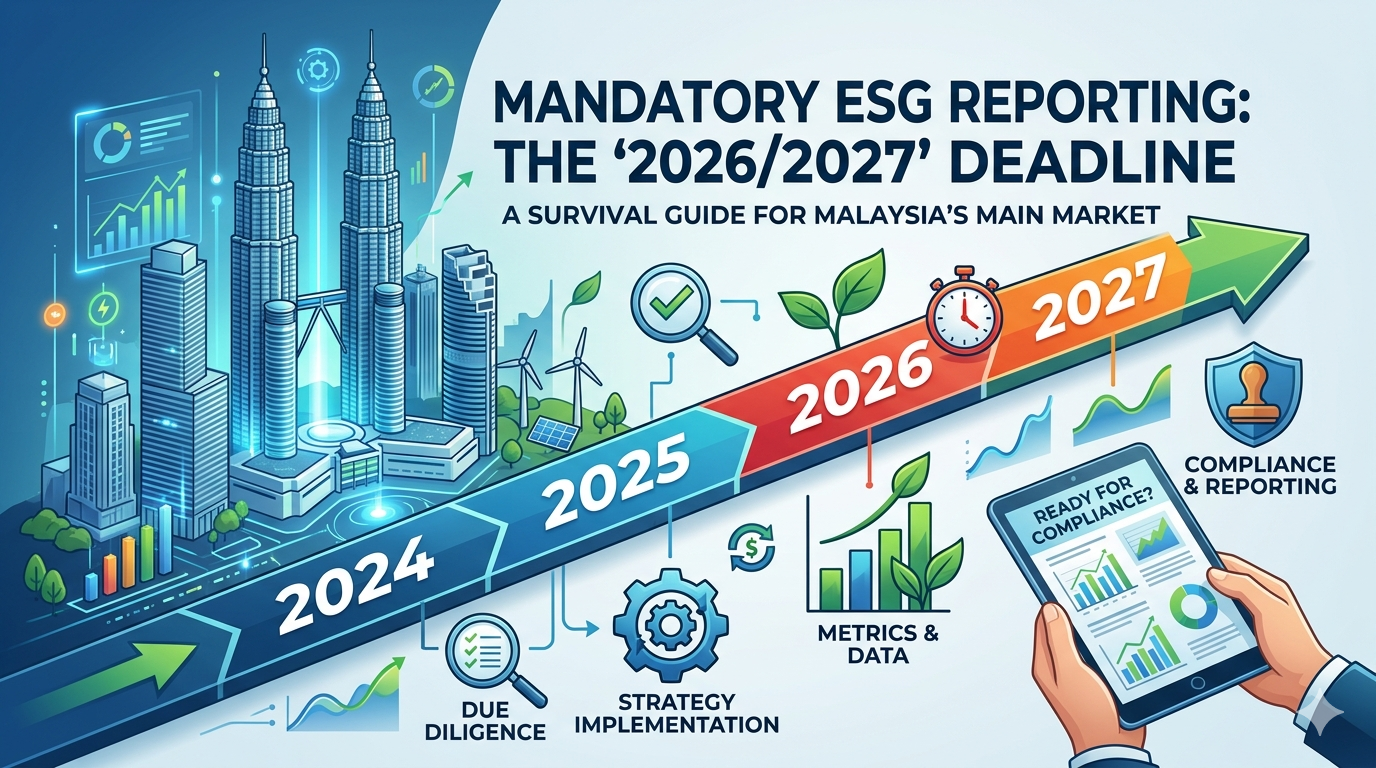

For years, ESG (Environmental, Social, and Governance) reporting felt like a “big company” problem—something for the top-tier giants with massive budgets and dedicated sustainability departments.
That era officially ends on 31 December 2026.
Bursa Malaysia has tightened the net, mandating that all Main Market issuers—not just the top RM2 billion cap companies—align their reporting with the global IFRS S1 and S2 standards. If you are a “Group 2” issuer, the clock is no longer just ticking; it’s practically ringing.
The New Landscape: Who, What, and When?
Bursa’s phased implementation is designed to give smaller players a grace period, but the “Ready or Not” moment for Group 2 is approaching fast.
| Group | Who are they? | The Deadline (FY ending on or after) |
| Group 1 | Main Market (Market Cap ≥ RM2b) | 31 December 2025 |
| Group 2 | All other Main Market Issuers | 31 December 2026 |
| Group 3 | ACE Market Issuers | 31 December 2027 |
The Mandate: You are now required to disclose climate-related risks and opportunities (IFRS S2) and general sustainability-related financial information (IFRS S1). This isn’t just about “recycling programs” anymore—it’s about how climate change affects your bottom line.
The Secret Weapon: Centralised Sustainability Intelligence (CSI)
To prevent a compliance nightmare, Bursa Malaysia introduced the CSI Platform. Think of it as the “tax filing software” for ESG.
Instead of guessing what to report, companies use the CSI to input data into a standardized framework. This platform is more than just a submission portal; it’s a tool for:
- Automated Carbon Calculation: Helping you track Scope 1 and 2 emissions without a PhD in environmental science.
- Standardization: Ensuring your data looks exactly like your competitors’, making it easier for analysts to digest.
- Global Export: The platform is designed to align with international standards, making Malaysian companies visible to global ESG funds.
Why Investors Care: Picking “Future-Proof” Stocks
The era of “ESG for branding” is over. Standardized disclosures under IFRS S1 and S2 provide investors with a comparable data set for the first time.
The Investor’s New Checklist:
- Resilience to Policy: Can this company survive a sudden carbon tax or a ban on certain plastics?
- Supply Chain Stability: Is the company’s supply chain exposed to flood zones or unethical labor practices that could halt production?
- Cost of Capital: Banks are increasingly offering “Green Financing”—preferential rates for companies with high ESG scores. A “Group 2” company with a solid CSI profile is a much safer bet than one scrambling to hide its carbon footprint.
Investors are using the CSI data to distinguish between companies that are transforming and those that are simply lagging. In a volatile market, “future-proof” is the only label that matters.
Proactive Steps for Group 2 Issuers
If you are in Group 2, don’t wait for the 2027 filing season to start thinking about this.
- Perform a Gap Analysis: Check your current data against IFRS S2 requirements today.
- Engage the Board: ESG is now a fiduciary duty. Board members need to understand that climate risk is financial risk.
- Master the CSI: Register for the platform early and run a “dry run” with your existing 2025 data.
The 2026/2027 deadline is a filter. On one side will be the companies that evolved into the new economy; on the other will be those that the market leaves behind. Are you ready?

Leave A Comment