
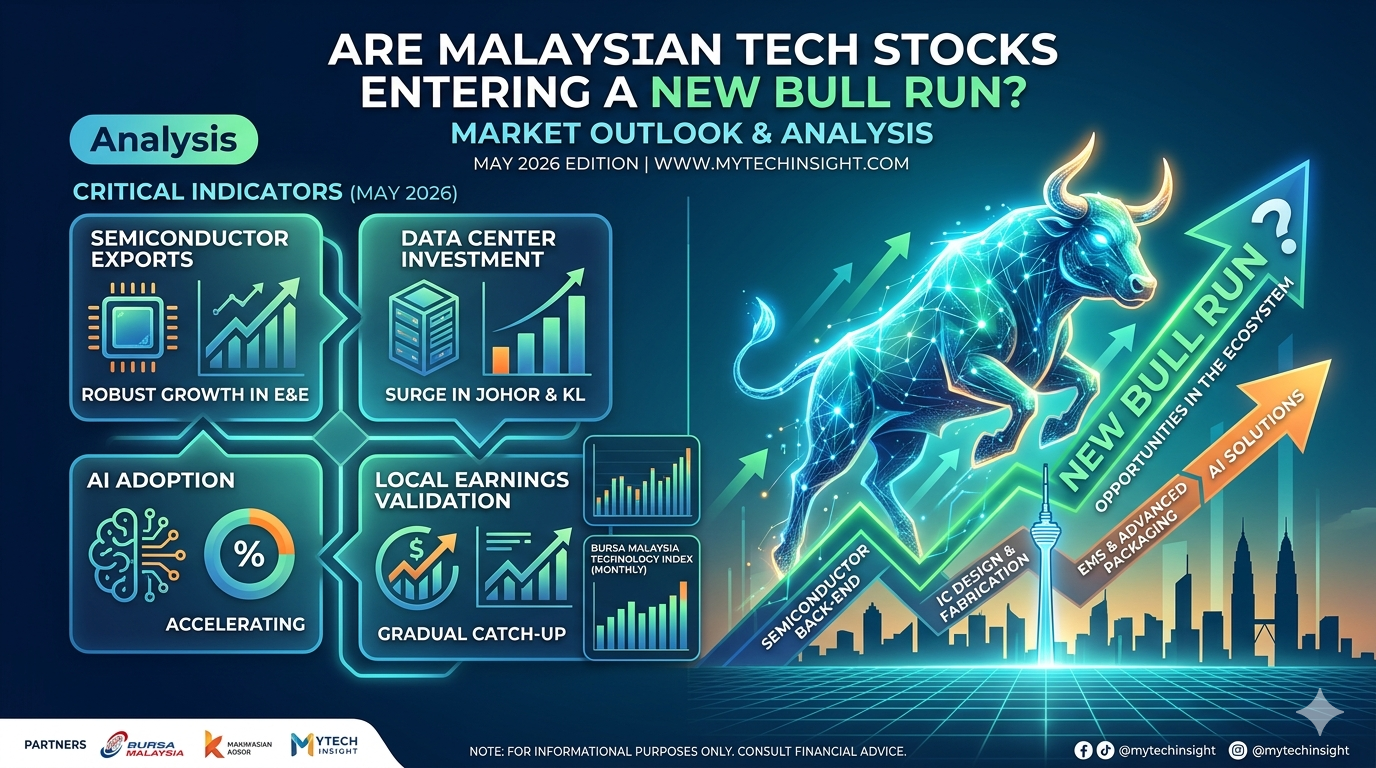

The Malaysian tech sector is waking up again — and this time, the rally looks more structural than speculative.
After spending much of 2024 and early 2025 trapped in a brutal semiconductor downcycle, Bursa Malaysia’s technology names are suddenly back in focus. AI-linked counters are leading gains, earnings momentum is improving, and global semiconductor sentiment has turned decisively bullish again.
The big question investors are asking now:
Is this just another temporary rebound — or the beginning of a genuine multi-year bull run for Malaysian tech stocks?
The answer may depend on one word:
AI.
Why Malaysian Tech Stocks Are Rallying Again
The latest surge in Malaysian semiconductor counters is not happening in isolation.
Globally, AI spending is exploding. Nvidia, AMD, Broadcom, TSMC, and even Intel have all reported stronger-than-expected demand tied to AI infrastructure, data centers, and high-performance computing.
That momentum is now flowing downstream into Asian semiconductor supply chains — including Malaysia.
Malaysia occupies a critical position in the global chip ecosystem:
- Semiconductor testing
- Chip packaging
- Machine vision inspection
- Precision engineering
- Wafer fabrication support
As AI servers and advanced chips become more complex, demand for testing, automation, inspection, and yield optimization rises sharply.
That directly benefits Malaysian players like:
- MPI
- ViTrox
- KESM
- Inari
- Frontken
And investors are starting to notice.
1. MPI — The Institutional Favorite Returning to Life
Among large-cap Malaysian semiconductor names, MPI is quietly regaining momentum.
The company operates in outsourced semiconductor assembly and testing (OSAT), making it highly leveraged to the global chip cycle. Recent market action suggests institutions are rotating back into export-oriented semiconductor names as AI demand accelerates.
Why MPI matters:
- Exposure to advanced semiconductor packaging
- Benefits from stronger utilization rates
- Trade diversion from China remains supportive
- High-quality institutional name
MPI is not usually the “hype” stock.
Instead, it behaves like a proxy for broader semiconductor recovery.
If global AI infrastructure spending remains elevated through 2026, MPI could become one of the safer large-cap ways to ride the cycle.
2. ViTrox — Malaysia’s AI Infrastructure Proxy?
ViTrox may be one of the strongest AI-linked stories on Bursa Malaysia right now.
The company specializes in machine vision inspection and automated test equipment — both increasingly critical as semiconductor complexity rises.
Its recent quarterly numbers were extremely strong:
- Revenue up 89.2%
- Profit after tax up 112.4%
- EPS more than doubled year-over-year
That is not “recovery” growth.
That is acceleration.
The key driver:
Demand for automated inspection systems tied to semiconductor manufacturing and AI-related electronics.
Why investors are excited about ViTrox:
- Strong earnings momentum
- AI manufacturing exposure
- High-margin automation business
- Structural semiconductor trend beneficiary
Among Malaysian tech names, ViTrox increasingly looks like a premium-quality growth stock rather than a cyclical rebound play.
3. KESM — The Quiet Automotive Chip Winner
KESM rarely gets the same attention as ViTrox or MPI.
But the company is deeply tied to automotive semiconductor testing — an area that could become increasingly important as EV adoption and smart vehicle technology expand globally.
What makes KESM interesting now:
- Semiconductor testing demand recovering
- Automotive chip complexity increasing
- AI integration into vehicles growing
- Share price already showing strong momentum
Its stock has reportedly gained more than 50% year-to-date.
That kind of move usually signals improving forward expectations.
KESM may not become the sector leader, but it could emerge as one of the strongest second-tier beneficiaries if semiconductor recovery broadens beyond AI hype.
4. Inari — The Apple Ecosystem Bet
Inari remains one of Malaysia’s most closely watched semiconductor names because of its exposure to RF chips and smartphone ecosystems.
Historically, the stock performs best when:
- Consumer electronics recover
- Apple supply chains strengthen
- Semiconductor cycles turn upward
But the bullish thesis is evolving.
Today, investors are increasingly looking at Inari as a potential beneficiary of:
- AI-enabled edge devices
- Advanced wireless connectivity
- Next-generation smartphone refresh cycles
The challenge?
Unlike pure AI infrastructure plays, Inari still carries more cyclical consumer exposure.
That means the upside could be strong — but possibly less explosive than companies directly tied to AI data centers or semiconductor equipment.
Still, if growth rotations continue, Inari could become a major laggard-to-leader recovery candidate.
5. Frontken — The AI Wafer Fabrication Play
Frontken might be the most underrated AI beneficiary on Bursa Malaysia.
The company provides critical engineering support and maintenance services to semiconductor wafer fabrication plants.
Why this matters:
AI chips require:
- Advanced manufacturing
- Extreme precision
- Higher wafer complexity
- Better yield management
That naturally increases demand for specialized semiconductor engineering support.
Analysts have repeatedly highlighted Frontken as one of the better-positioned Malaysian names for AI-linked semiconductor demand.
Unlike speculative AI narratives elsewhere, Frontken’s business is directly tied to real semiconductor production activity.
That gives the story credibility.
So… Is This Really a New Bull Run?
There are several reasons this rally could be more durable than previous semiconductor rebounds.
1. AI Is a Structural Shift, Not a Short-Term Trend
Previous chip cycles were driven mainly by:
- Smartphones
- PCs
- Consumer electronics
AI changes the equation entirely.
The infrastructure buildout required for AI is massive and multi-year in nature. Analysts increasingly describe AI as a structural technology transformation rather than a temporary demand spike.
That potentially creates a longer earnings runway for semiconductor-related companies.
2. Malaysia Is Becoming More Important Globally
Malaysia’s semiconductor ecosystem continues gaining strategic relevance due to:
- US-China supply chain diversification
- “China+1” manufacturing strategies
- Government semiconductor initiatives
- Expansion in advanced packaging and testing
This could attract additional foreign direct investment into Malaysian tech manufacturing over time.
3. Earnings Are Finally Improving
For most of 2024 and early 2025, tech stock valuations ran ahead of earnings.
Now the opposite may be happening.
Companies like ViTrox are beginning to post genuine operational acceleration again.
If earnings growth broadens across the sector, valuation concerns become less problematic.
But There Are Still Risks
This is not a risk-free bull case.
Investors should still watch for:
US Semiconductor Tariffs
Geopolitical risks remain elevated, especially surrounding US semiconductor policy.
Currency Risk
A stronger ringgit can pressure exporter earnings.
Valuation Excess
Some AI-linked counters may become overheated if speculative momentum accelerates too quickly.
AI Expectations
Not every semiconductor company will benefit equally from AI.
The winners will likely be selective.
Final Take
The setup for Malaysian tech stocks is becoming increasingly compelling.
This rally is being driven by:
- Real AI demand
- Semiconductor recovery
- Improving earnings
- Supply-chain diversification
- Institutional rotation back into growth sectors
That combination is far more powerful than a simple technical bounce.
The most important distinction:
This cycle appears increasingly tied to structural AI infrastructure spending rather than temporary consumer-electronics demand.
If the global AI boom continues into 2026 and beyond, Malaysian semiconductor names could still be in the early stages of a much larger re-rating cycle.
And if that happens, stocks like MPI, ViTrox, Frontken, Inari, and KESM may only be getting started.

Leave A Comment